AI will absolutely save you time, but that's not the breakthrough. The breakthrough is what you do with the space that it creates.
Now, most founders use AI for productivity, but very few use it for capacity. And capacity is what changes the shape and trajectory of your business.
Using AI to touch fewer things changes your role as founder. And using AI to decide things just once changes the structure of your business. But there's the third level that people don't design for, and that is capacity.
What actually happens when you regain capacity?
Well, for me personally, when I removed the distribution bottleneck in my business, it didn't just save time. It genuinely changed the shape of my week.
So even when AI was there helping me produce content faster and better, I was still the checkpoint for posting, editing, approving, checking descriptions, and making all those small decisions about where things went and when they were published. So every little bit circled back to me. So even when Monday was allocated for content, it wasn't a clean, productive, high-value day. There were loose ends everywhere.
And the more of the work that I enjoyed, like thought leadership, recording videos like this, writing emails to my community, that translated into more homework that I needed to do myself afterwards. So as much as I was using AI to make parts of it faster, I still owned the projects.
And that creates a disconnect, because I was wanting to do more of the stuff that I love, like the videos, but I wasn't drawn to all of the baggage that was attached to it, which was the editing and the distribution and all of that other admin stuff required with the production.
You might move faster doing the bits that you love, but if that makes more homework for the bits that you don't love, it's going to drag everything down.
Not to mention it makes your business less enjoyable. And the moment that stuff grinds to a halt, it becomes a problem. And same deal with any part of your business.
What does it look like once the workflow is built?
Now, having used AI to help build the proper workflows and playbooks, I only do the parts that I actually want to do. The thinking, the recording, the strategic stuff. And everything else, like admin and distribution, is handled downstream.
So quite literally, the transcript from a video goes into a playbook. It creates the description, it formats it properly, the SEO is handled, the schema is applied, all the technical stuff happens, and then it is all packaged up for a human VA to apply to YouTube or my blog or LinkedIn or wherever it needs to go.
So a VA, a virtual assistant, can oversee the whole system. AI, artificial intelligence, runs the entire system, and it doesn't come back to my desk unless I deliberately choose to review it. And quite honestly, I'm very comfortable not reviewing every little piece right now, because I know the checks and balances are in place with the systems as well as the VA reviewing it. If you want the mechanics of how the context and the doing fit together, I've written about that in the brain and the hands.
So that shift has given me something far more valuable than just hours saved. It's actually given me clean mental bandwidth, and that is priceless. Because once I saw what was possible here, I could apply that same AI lens to other parts of the business.
How has it changed the shape of your week?
And now the shape of my week is radically different. I can have, or I choose to have, themed days that I can stick to and that are productive.
- Monday is my content day, doing stuff like this, the video, the newsletter. And then I meet with my VAs for half an hour in the afternoon, and they take care of the rest, as well as the AI playbooks.
- Tuesday is my client delivery day, which is really enjoyable and energising, because I get to spend all day with my clients and I'm in that frame of mind.
- Wednesday is when I work on my own AI projects and work with my own AI coach.
- Thursday is for speaking and IP development.
- Friday is an open day. Free space, lots of thinking time.
But it goes further than that, because this capacity has let me bake proper boundaries into the business. So I know that I only start work at 9:30. Up until that point I'm playing with the kids and getting them ready for the day. And by the time I finish at 4:00 at the latest, I know that there's time for going to the park with the kids, there's time for training, and there's also time in the middle of the day to play with the kids and have lunch with them.
So they are all the flow-on effects from having the capacity from AI making my business better.
Why does the thinking time matter so much?
And the other thing that I personally like about this is that there's time in my week for all the important stuff that gets neglected when you get busy with execution. The IP development, the working on my own AI projects, and even that thinking time. That is super, super valuable stuff, but it's too easy to neglect all of it when your week is busy with execution, execution, execution.
And AI is a trap sometimes, because it makes you do that stuff faster, when in fact what we really want to do is use AI to save time initially, but not simply refill the calendar with more execution, more output, more busyness. That keeps you in the weeds and playing at a very basic level. It's the same pattern I described in the AI mistake that looks like progress.
Moving upstream is different. Upstream is where you can step back and ask whether you're positioned properly for the level you now operate at. Checking whether the direction of the company is clear. Working out where the innovation is actually coming from. You can focus on strategic partnerships, or on the platforms that are going to increase demand and raise your visibility with the right people.
Founders shouldn't be optimising tasks all week. They should be shaping the direction of the company.
So this isn't about task optimisation, it's about shaping trajectory. And AI supports that when it removes the rethinking, the reworking and the redeciding.
What's the difference between AI as productivity and AI as leverage?
So we don't want AI exclusively as a productivity layer. That's important as an entry-level step. What we want next is AI as leverage, because it's captured our judgement, it removes those recurring decisions, and it removes the operational friction.
So when all that happens, you build capacity. That capacity means you've got the bandwidth. You can be more strategic. You can design your week and structure your business in a way that helps you make better decisions. And those better decisions compound over time. And that's what you're really looking for with AI. I've written more about what stalled decisions actually cost in decision paralysis.
All of that stuff happens downstream from the clarity and the capacity.
So the real question is, what are you going to do with the capacity that AI frees up? Because the answer to that determines whether the business improves and life gets easier, or whether you're stuck using AI but just spinning your wheels faster, with more noise and output and activity.
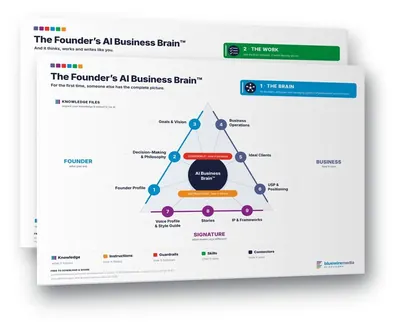
Want the AI starting from your thinking? The Founder's AI Business Brain template is how you get what's in your head into something that thinks, writes and works like you. Free to download.
Frequently asked questions
What is the difference between AI productivity and AI capacity?
Productivity is doing the same work faster. Capacity is the space that opens up when work stops coming back to your desk at all. Most founders use AI for productivity and very few use it for capacity, and capacity is what changes the shape and trajectory of the business.
Why doesn't saving time with AI automatically help?
Because it's easy to refill the calendar with more execution, more output and more busyness. That keeps you in the weeds and playing at a very basic level. AI is a trap sometimes, because it makes you do that stuff faster rather than freeing you from it.
What are the three levels of using AI?
Using AI to touch fewer things changes your role as founder. Using AI to decide things just once changes the structure of your business. The third level is capacity, and that's the one people don't design for.
How do you stop content work coming back to your desk?
Build the workflow and the playbook, then hand the publishing to a person. The transcript goes into a playbook that writes the description, formats it, handles the SEO and applies the schema, and then it's packaged up for a VA to publish. A VA, a virtual assistant, oversees the whole system, and AI runs the entire system.
What does a themed week look like?
Monday is content plus half an hour with the VAs. Tuesday is client delivery. Wednesday is my own AI projects and my own AI coach. Thursday is speaking and IP development. Friday is an open day with thinking time. Work starts at 9:30 and finishes at 4:00 at the latest.
What should founders do with the capacity AI frees up?
Move upstream. Step back and ask whether you're positioned properly for the level you now operate at, whether the direction of the company is clear, where the innovation is coming from, and which partnerships and platforms raise visibility with the right people. Founders shouldn't be optimising tasks all week.