Most experienced business owners aren't actually behind with AI. They're just getting the sequence wrong, and that is far more dangerous.
AI doesn't just make you faster. It amplifies whatever judgement already exists. So if your thinking is clear, AI is powerful. And if your thinking is fuzzy, AI will scale that too.
That's why the sequence matters. You see, there are three levels that AI touches inside a business, and most people work through them in exactly the wrong order. The right order runs judgement first, then structure, then execution.
What are the three levels AI touches in a business?
Now, execution is the surface layer. Drafting, meeting summaries, rewriting stuff, doing some content, getting tasks done faster.
Then structure is how the work flows. The repeatable processes, the systems, the way things get built in the business.
And then judgement is the top level. The strategy, the positioning, the pricing, the hiring and firing, the risk, the capital allocation, the direction of the business.
Using AI at any of them is fine. The problem is the order you do them in.
Why does getting the sequence wrong feel like progress?
Most people move through these levels in the order that they discover them. They start with execution, because that's what AI makes obvious. Then they begin building structure around it. And only later, at the end, do they step back and ask, is this even the right direction?
So that's the mistake. The tools are impressive and easy to use, and the speed feels like progress.
But once something is baked into how you operate, it becomes much harder to interrogate. It feels official. It feels productive. And AI is very good at helping you scale whatever judgement exists, good or bad.
What is the right sequence for experienced business owners?
If you're an experienced business owner, the sequence is reversed. It's a countdown.
- Judgement. Are we solving the right problem? Is this aligned with the strategy? And does this project deserve our attention and capital and energy?
- Structure. If we are doing it, what is the right process? What should we repeat? What shouldn't we do? And where does AI genuinely remove friction?
- Execution. Now, how do we use AI to move quickly on something that is already clear, already stress tested, and is the right direction?
Execution should sit on top of the structure, and the structure should sit on top of the judgement. So speed should only be applied once you've got that total clarity.
Why does AI amplify bad judgement as easily as good judgement?
AI is scaling whatever thinking you bring it.
The risk isn't moving slowly. In fact, you want to be moving slowly. The risk is about locking in the wrong judgement at scale.
But that amplification before the actual clarity quietly compounds a misalignment. A mistake at the execution level is easy to reverse. Wrong email, you fix it. But a mistake at the judgement level, the direction, the positioning, the problem you're solving, is much harder to undo once it's built into how the whole operation runs.
The sequence that builds real leverage
So it's not about the speed. It's about the sequence. Judgement first, structure second, then we can move to speed of execution.
If you've built a reputation on the quality of your thinking, the question is how do I make sure AI is amplifying the right thinking. Get the direction right, then use AI to move fast on something that's already been stress tested.
That's how you stay ahead and create real leverage.
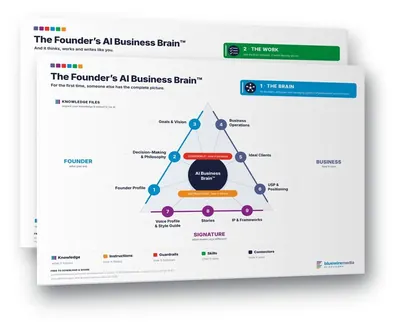
Want the AI starting from your thinking? The Founder's AI Business Brain template is how you get what's in your head into something that thinks, writes and works like you. Free to download.
Frequently asked questions
What is the most common AI mistake experienced business owners make?
Applying AI in the wrong order. Most people start at the execution level, drafting and automating tasks, before the judgement layer is settled. When speed gets applied to a direction that hasn't been thought through properly, AI compounds the misalignment instead of creating leverage.
What are the three levels AI touches in a business?
Execution is the surface layer, so drafting, meeting summaries, content and task automation. Structure is how the work flows, the repeatable processes and systems. Judgement is the top level, the strategy, positioning, pricing, hiring and firing, risk and capital allocation. The level most people start at is the one that should come last.
What is the right sequence for using AI in a business?
Judgement first, structure second, execution third. Confirm you're solving the right problem and the direction is sound. Build the right process around that. Then apply AI speed to execution on something that has already been stress tested.
Why does the AI sequence mistake feel like progress?
Because the output at the execution level is immediate and impressive. Faster emails, automated summaries, more content. It feels productive. The trouble is that all that activity can be pointed in slightly the wrong direction, and the more structure you build around it, the harder it gets to go back and question the direction.
Why does AI amplify bad judgement as easily as good judgement?
AI doesn't evaluate the quality of your thinking, it scales whatever thinking already exists. If your positioning is clear, AI makes you much more effective. If your direction is slightly off, AI helps you move that way faster and with more confidence. So small errors compound out of sight and get costly to reverse once they're embedded in systems.
Is it better to go slowly with AI?
At the judgement level, yes. The risk isn't moving slowly, it's locking in the wrong judgement at scale. Once the direction is clear and the structure is right, execution gets fast, and the speed goes somewhere worth going.