AI feels generic because it is a smart stranger. Out of the box it can think and write, but it doesn't know your business, so it guesses, and it guesses in the safest, most average way it can.
The fix isn't a cleverer AI or a longer prompt. It's context. When you give AI the founder's knowledge, the way the business actually works, and the voice it's written in, it stops guessing and starts doing partner-level work in your real situation. That structured context is what I call an AI Business Brain.
Why does AI answer like a smart stranger?
Most people meet AI, ask it something about their work, and get an answer that is confident, well written, and slightly off. Not wrong exactly. Just generic. Textbook advice, not yours.
That's not a flaw you fix with a better prompt. It's the honest result of talking to something that has read everything and knows nothing about you. A smart stranger can only give you the average answer, because the average is all it has.
Meanwhile, the thing that would make the answer good is sitting in your head and in the way your business runs. How you make decisions. What your clients actually worry about. The offers, the positioning, the phrases you use, the lines you never cross. None of that is in the model. So the model reaches for the average, and you get generic.
What is an AI Business Brain?
An AI Business Brain is a private AI advisor built around the founder, so a generic AI stops guessing and starts working in the business's real context. It isn't a smarter AI. It's a contextualised one.
The difference matters. Everyone has access to the same models. The edge isn't the tool, it's how much of your context the tool can reason with. Give it none and you get a smart stranger. Give it the right context, structured properly, and you get something closer to a partner who has been in the business for years.
What are the five layers of an AI Business Brain?
A Brain is built in five layers. Each answers a different question.
| Layer | What it is | The question it answers |
|---|---|---|
| Instructions | The system prompt, how it thinks | How should it reason? |
| Guardrails | Tone, ethics, limits | How should it behave? |
| Knowledge | Nine core files (below) | What does it know? |
| Connectors | The apps and data it plugs into | What can it see? |
| Skills | The tasks and workflows it runs | What does it do? |
Most people only ever touch the first layer, and only barely. They write a prompt and hope. The Brain treats the prompt as one layer of five, and the knowledge layer is where the real work is.
What are the nine knowledge files?
The knowledge layer is nine files, grouped in three pillars. Build a first version from about five core files, then roll in the rest. Together they become one system prompt the AI reasons from.
- Founder, what it knows about you: your profile, how you make decisions, your goals and vision.
- Business, what it knows about the business: how you operate, who your ideal clients are, your positioning and USP.
- Unique Personality, what makes it sound like you: your frameworks and IP, your stories, and your voice and style guide.
That last pillar is the one people skip and the one that matters most. It's the difference between AI that is correct and AI that sounds like you wrote it.
What does it actually do?
Once the context is in place, the Brain does real work, not demos. Prepare client meeting briefs, the sort of work an accounting practice or a law firm repeats every week. Draft client reports. Capture a team member's process into an SOP. Summarise a long contract. Write the weekly newsletter in your voice. Draft the LinkedIn post you keep meaning to write. The tasks are ordinary. Doing them in your real context, at partner level, is not.
When does an AI Business Brain work, and when doesn't it?
The Brain works when there is something to capture. It extracts what already exists, your IP, your reputation, your clients, the way you reason, and installs it. That means it suits an established business, not someone starting from zero. If there is nothing in your head and no track record to draw on, there is nothing yet to build a Brain around. For everyone else, the raw material is already there. It has just never been written down in one place.
The honest comparison
A great hire takes about ninety days to learn a business well enough to be trusted with the real work. A Brain does it in one sitting. And unlike a hire, it never forgets what you told it, and it never leaves.
The reaction I hear most at install is not about the technology. It's this: "For the first time, someone else has the complete picture. It's not just me."
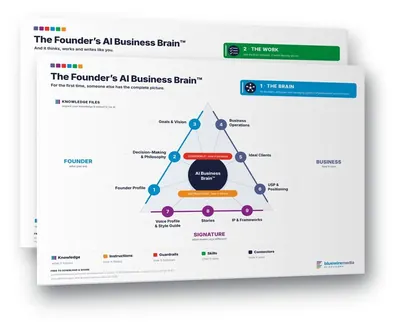
Want the AI starting from your thinking? The Founder's AI Business Brain template is how you get what's in your head into something that thinks, writes and works like you. Free to download.
Frequently asked questions
Why does AI give such generic answers?
Because out of the box it doesn't know your business, so it defaults to the safest average answer. It has read everything and knows nothing about you. Give it your real context, structured properly, and the generic answers stop.
What is an AI Business Brain?
A private AI advisor built around the founder and the business, so a generic AI reasons in your real context instead of guessing. It is five layers: instructions, guardrails, knowledge, connectors and skills, with the knowledge layer holding nine files about you, your business and your voice.
Do I need to be technical to build one?
No. The work is capturing what you already know, not coding. If you can describe how your business runs and how you make decisions, you have the raw material.
How is this different from just writing a good prompt?
A prompt is one layer of five, and the shallowest one. A Brain adds the guardrails, the knowledge, the connectors and the skills, so the context is permanent and reusable rather than re-typed every time.
Who is it for?
Established professional services firms and founders who have real IP, a track record and clients to draw on. It captures what exists, so there has to be something to extract.