Most people use AI like a bit of a tool, or maybe even just a play-around type of thing. But if you're a business owner and you're serious about putting time back in your calendar, an AI prompt library is where I would start.
And when I say time back in your calendar, I mean time for the things that you love, whether that's on the work side of things or just your personal life.
What is an AI prompt library?
So, we want to build an AI prompt library for all the routine, repetitive tasks that you do in your business. You write one prompt per task, you write it properly once, and you store it somewhere the whole team can get to it.
So when someone in your organisation has to do that task, they go straight to that prompt library, they take the prompt, and they get ChatGPT's help.
How do you build one?
So we want to go through all the parts of your business and actually write down the process, or write down the actual task of what it is that you do. And therefore, we're doing an audit to uncover all the parts of the business that we can then get AI's help to do for us.
You should end up with sort of 15, 20, maybe 30 different parts of the business, all with separate SOPs or processes. That list is your raw material, and it's usually the first time an owner has seen the whole lot written down in one place.
And you're looking for the tasks that already eat your week, which is the same logic I use with clients in the quick win method for starting with AI. It's also the exercise we run in the hands-on set up AI in a day workshop, because they build their own library in the room.
What makes a good prompt?
A lot of business owners are making life hard for themselves when they use AI, because their prompting isn't great. Now, of course, the saying goes, garbage in, garbage out.
So we want to follow a consistent framework. Now, there are four components to the perfect prompt framework, and they go in this order.
1. Give it a role
You assign a role to the AI. So you say "you are a" whatever it is. You are a copywriter. You are a property manager. You are a marketing expert.
2. Give it the task
Then you're telling it what task it is you want it to perform. Your task is to write an email. Your task is to prepare a blog post.
3. Give it the context
So this is where you say "for extra context", or "as additional background information, here's all the other stuff you need to know about". Now you might copy and paste this in, like an email chain. Or maybe you upload it as a PDF brain dump of all the extra knowledge that adds context to it.
And context is the component people skip, and it's the one that decides whether the answer sounds like your firm or like everybody else's. If your outputs keep coming back bland, that's usually why, and I've gone through it properly in why AI gives you generic answers.
4. Specify the output
And then the fourth component is to specify the output that you want. Do you want an email? Do you want a chart? Do you want an Excel spreadsheet? So you nominate what output you want from the AI.
So that is the perfect prompt framework. Role, task, context and output. Use that framework each time and you will get much, much better results.
How much time does a prompt library actually save?
Now, this should increase the speed of doing these tasks maybe by 10 minutes for some tasks, 30 minutes for other tasks.
But when you tally that up across your day, and your week, and your team's week, that's where the value really starts to compound. So, create an AI prompt library for your business and put at least 5 hours per week back in your calendar.
What changes when the whole team uses it?
And everyone in your organisation goes to the same place for the same task, so the work comes out consistent, and somebody new can do a reasonable job of something in their first week rather than their first quarter.
That bites hardest in professional services, because so much of what a firm does is the same job repeated with different names on it. It's why the accountants I work with through AI Edge masterclasses tend to get to the library stage quickly.
And once the library exists, you've got the groundwork for handing real work over rather than just asking questions, which I wrote about in does your AI have a brain but no hands.
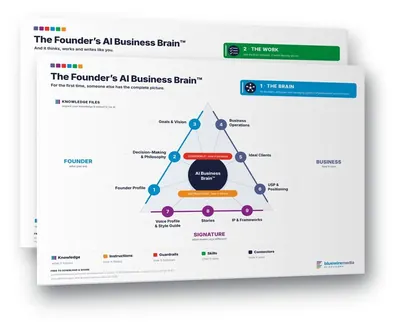
Want the AI starting from your thinking? The Founder's AI Business Brain template is how you get what's in your head into something that thinks, writes and works like you. Free to download.
Frequently asked questions
What is an AI prompt library?
It's a documented set of prompts for the routine, repetitive tasks in your business. You write one prompt per task and store it somewhere your whole team can reach, so everyone goes straight to the library when that job comes up.
How do you build an AI prompt library?
Start with an audit. Go through all the parts of your business and write down the process, or the actual task, of what it is that you do. You should end up with 15, 20, maybe 30 different parts of the business, each with its own SOP or process. Then write one prompt per task and document it.
What are the four parts of a good AI prompt?
Role, task, context and output. You assign the AI a role ("you are a copywriter"), you tell it the task ("your task is to write an email"), you give it context as background information or an uploaded brain dump, and you nominate the output you want, whether that's an email, a chart or a spreadsheet.
How much time can an AI prompt library save?
Maybe 10 minutes on some tasks and 30 minutes on others. But when you tally that up across your day, your week and your team's week, that's where the value really starts to compound. The target I set is at least 5 hours per week back in your calendar.
Why do my AI prompts give bad results?
Usually it's the prompting. Garbage in, garbage out. Most weak prompts are missing the context component, so the AI has no idea about your business and reaches for a generic answer instead.
Should the whole team use the same prompt library?
Yes, and that's where most of the value sits. When everyone goes to the same place for the same task, the work comes out consistent, and a new person can do a decent job of it much sooner.