Most established professionals know they need to be doing something with AI, but they don't have any idea where to start.
Now every time you open LinkedIn or Instagram or Facebook or X or whatever, there's a million different tips, ideas, prompts, skills, all that stuff flooding your feed. So even if you're interested and motivated to embrace AI, it's very, very hard to know what the first thing to do is.
And then when you talk to more corporate strategic type people, they say, well, you've got to start with an AI strategy. And of course that's this big, fluffy, six-month sounding sort of project. So in the end, nothing happens.
Why does starting with an AI strategy stall?
Now yes, it's important that AI knows all about your business. That's important. That does take a little bit of time. But what's also important is getting some quick wins and getting a task off your plate, so that you can actually see the AI working to make your life easier and to actually do some of the tasks for you.
Which task should you pick first?
So what I like to do is help people understand, or even just look at their calendar, or look at their inbox, or look at the tasks they've done that day, and ask: what is a time-consuming, laborious or repetitive task that I have had to do today or in the last three days?
So we pick one of those. For example, I work with a property specialist and they write investment reports. That usually takes somewhere in the range of three to four hours once you've looked at all of the different components, analysed it, and produced a report.
How this works step by step
- Look for an example of the finished product you've done before. You've done this task heaps, so you've got loads of examples. Pick one of your most recent or one of your best. It might be a Word doc or a spreadsheet. Give it to your AI and say, here is the outcome of what we want to be doing, so it knows the target.
- Say, can you analyse exactly the format, the structure, and everything about this finished product. It will give you that analysis of the format and the structure.
- Give it the inputs you were working with to get to that finished output. It might be transcripts, it might be going to certain web addresses, it might be reading information. Whatever those inputs are that you as a human, that you as a trusted adviser professional read, look at, watch or whatever, hand those over and ask it to read and analyse them.
- Say, now that you've been able to go from the inputs to the outputs, can you please document the process, exactly how you do it. It will give you a standard operating procedure, or an SOP, or a procedure that you can look at and go, oh yes, that's exactly how I would do it. Or maybe that's even better, because the AI has used its own intelligence.
- Say, here's another transcript or a different set of inputs. Can you now take those, follow this process, and produce the output. Then review it, see if it's any good, and give it any tips for improving.
What the results actually look like
And the reality is, doing that for one of the tasks that's on your plate in your calendar, the AI is going to do pretty much a fabulous job of it. You still need to review it at the end.
But what you're going to find is that if it's anything like my clients, whether they're lawyers or accountants or financial advisers or mortgage brokers or property specialists, there are nearly always tasks that you can actually hand over to the AI and follow that exact process.
The property specialist saves three to four hours every single time, and that process can then be used by other people in the team. Lawyers are helping Claude write affidavits and statements. Accountants and business advisers are doing client reports in a fraction of the time, because we've trained it up to perform that specific task.
Every single quick win that you have just puts a little bit more space into your calendar, so that you can then look at another task or project that you can get off your plate.
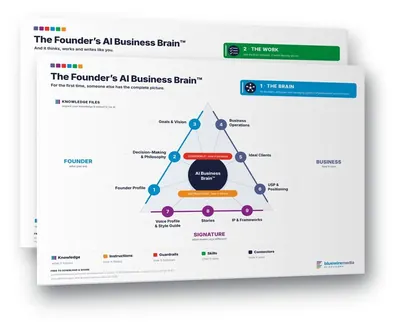
Want the AI starting from your thinking? The Founder's AI Business Brain template is how you get what's in your head into something that thinks, writes and works like you. Free to download.
Frequently asked questions
How do you start using AI in your business?
Start with a quick win rather than a strategy. Pick one time-consuming, laborious or repetitive task from the last three days, then teach AI to do it by showing it a finished example, giving it the raw inputs, and asking it to document the process in between.
Should you begin with an AI strategy?
For most established professionals, no. An AI strategy tends to become a big, fluffy, six-month sounding project, and in the end nothing happens. Getting one task off your plate lets you actually see the AI working to make your life easier.
How do you choose the first task to give AI?
Look at your calendar, your inbox, or the tasks you've done today, and find something time-consuming, laborious or repetitive that you've had to do in the last three days. Recurring work with existing examples is ideal, because you already have the finished products to train it on.
Why give AI the finished product first?
So it knows the target. Once it can see what good looks like, and then sees the raw inputs you started from, it can work out the process that gets from one to the other and write that up as a repeatable procedure.
How much time can this save?
The property specialist in this example saves three to four hours on every investment report. Lawyers, accountants, financial advisers, mortgage brokers and property specialists nearly always have tasks that follow the same pattern.
Can the process be shared with the rest of the team?
Yes, and that's a large part of the value. Once the procedure is documented it can be used by other people in the team, so the saving repeats rather than sitting with one person.