If you're a coach or a consultant or in professional services without custom GPTs, you're about to be left behind.
Why? Because people who expect their clients to perform tasks and to do work need to make it as easy as possible.
So anytime you're coaching, consulting or providing advice and you need your clients to perform a task, what you need to do is make that as easy as possible for them. And the smart coaches, consultants and professional services practitioners are using AI, and specifically custom GPTs, to take what would usually take say 10 hours and bring that task down to 30 minutes.
Now, a lot of the time when you stack those tasks together, the good consultants and the good coaches are finding that you can get through six months worth of work in a couple of weeks.
What did client work look like before AI?
So anytime you've got a task, in the olden days before AI, what you would normally do is you would normally give your clients worksheets, frameworks, tutorials or videos to watch.
Now, of course, that would be very time intensive, and they would have to do a lot of the thinking and do a first draft, second draft, come back to you as the coach, consultant or professional advice provider, and it would be a back and forth process. It would take months and months and months.
Usually the good consultants in this scenario would provide a set of instructions or an SOP, a standard operating procedure. Instructions, process, SOP, it all means the same thing. But at least that way your clients can follow step by step and get to the exact outcome that they need to. Now, it's still going to take time, but at least that is an easier thing for your clients to follow.
Where is the line in the sand?
Thankfully, now in the age of AI, this process is a lot easier. So, there is a very big line in the sand here of where pre-AI thinking is dominating and then post-AI thinking. Everything above is pre-AI thinking. And then this is where you want to be. This is AI thinking.
So, what's happening here is that if you've got an SOP that you expect your clients to follow, you can very easily create an AI prompt that enables them to get that result much, much faster.
You would follow the perfect prompt framework, assigning a role, saying what the task is, giving it the appropriate context, and defining the output that you want. I've set that four-part framework out in full in the prompt library post. This alone is going to 10x or 20x the speed and quality of what your client is capable of doing. So that's a huge win.
What does the top 1% do differently?
However, the top 1% of coaches, consultants and professional advice providers are going the next level. They take a prompt, or a series of prompts, whatever the client needs to do to perform that task, and they then create a custom GPT that has all of that process baked into it.
So the client, all they need to do is just interact with the GPT, and the GPT does the heavy lifting.
For every process and every task, what we want to be doing as an AI enabled business owner is to think what GPT can perform this task faster and better and more reliably.
So it's super, super important. And it's the same thing I bang on about with giving your AI hands as well as a brain.
How many GPTs do you actually need?
Now I just want to give you a quick example. I mean, I have got so many GPTs pre-saved here on my stream deck. They're the ones that I use all the time. There's more. So some of these are ones that I built myself. Some of these are ones that my coaches have built and I use.
And then you want to build out a library of these GPTs. It's the same thing as replicating yourself, except you're doing it for your clients.
Why is this on you rather than on the client?
As a coach, consultant or professional advice provider, it is incumbent on us to provide these tools to our clients so that they can get better results and faster results.
And it actually makes you look better, and it makes your life easier, because they are doing what they're meant to and making you look good.
So any task you expect your clients to do: develop the SOP, create the AI prompts, and then bake them into a custom GPT.
What does this do to your delivery timeline?
And you will make your client's life so much better and faster, and your business is going to be much more sticky, because why would they go anywhere else?
Because you're condensing and collapsing time. Six months of stuff can be done in a couple of weeks now, thanks to this idea of an AI accelerated delivery model.
I do this exact thing in accounting firms and in financial advice practices, and it's one of the things I walk through in my keynotes.
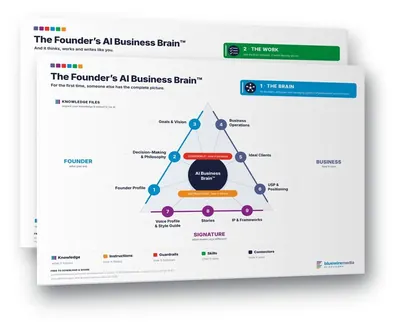
This works best on your own material. The Founder's AI Business Brain template is how you get what's in your head into something that thinks, writes and works like you. Free to download.
Frequently asked questions
What is a custom GPT?
It's a version of a chatbot with a process baked into it, so the person using it does not have to know the prompt or the steps. All they need to do is interact with the GPT.
Why not just give clients a prompt?
A prompt works, and it will 10x or 20x what your client can do on their own. A custom GPT goes a level further because the client no longer has to hold the process in their head. The process lives in the tool.
Where do I start if I have no GPTs at all?
Start with the SOP you already have. Take one task you expect clients to do, write the instructions down, turn those instructions into an AI prompt, then bake that prompt into a custom GPT.
How much time does this actually save?
Something that would usually take 10 hours can come down to about 30 minutes. Stack several of those together and six months of client work can be done in a couple of weeks.
Does this make clients less likely to need me?
The opposite. It makes your business more sticky, because the tools are yours and the results are faster. Why would they go anywhere else?
Who is this for?
Coaches, consultants, and anyone in professional services who expects clients to perform tasks between sessions.