Most business owners are sitting on a mountain of client testimonials, but they fail to ever collect them.
Now, I know how it can turn weird really quickly as soon as you say, hey, can we do a video where you give me a testimonial? That tends to have people just saying what they think you want to hear, and it sounds all artificial and not very compelling.
So I have got a solution that addresses this problem, and it's never ever awkward.
What is the Fathom technique?
So, it's called the Fathom technique. And basically, all we're doing is we are recording a debrief call with our clients once a good project is underway or comes to an end.
So, all we need to do is basically say to the client, look, we're getting some good results, could we jump on a debrief call so that I can fully understand exactly the process you've gone through in this journey, so that I can continue to improve and I can understand where we can take your journey next.
So we jump on a call, and we record it with Fathom. Now if you're like me, all of your coaching calls are recorded just so that we can refer back to what was said. We understand that there's a record, and this is exactly what you want.
What do you actually ask on the call?
So we jump on a call and we ask the customer very simply. We go, let's talk about before the project started. What were the pain points that you were experiencing? Where were your frustrations and difficulties?
So they then simply start rattling off all of these different before scenarios where they were in pain.
And then you say, well, now talk to me about the after. So where are you today? What does life look like for you right now? And they will talk about all the big green ticks of everything that is great about where they are now.
And then finally, you get to ask them what were the things that you did in order to get from before to where you are now on the after column. And they will talk to you about all these things in the middle. And these are the things that your program or your coaching or your services have done for them.
Why does before, after and bridge work so well?
So that means anybody who's watching the video can then relate to what's in the before column and go, yes, I relate to those pains. And they're going to be using the exact language that resonates with your prospects.
And then when they talk about the after column, all your prospects who are watching it, they're going to be going, you know what, that's exactly what I want.
And then they understand that there is a bridge. There's a bridge in the middle for getting there, and that is engaging your services.
And it's their language, not yours, which is why I'm so keen on capturing your own stories properly too.
Are there different versions of the questions?
So there is a template, and there are variations of different questions depending on how long and detailed you want to make your case study. If you want to get your hands on it, you can download the case study framework template, pop your details in, and it gets sent to you as a Google doc.
There's one in there with a hat tip to Sean D'Souza from Psychotactics. There's a seven-part framework here. It's very much what was the situation before, what was it afterwards, and bridging the gap. And of course there's a longer format one if you really want to go in depth, in sort of a half hour, 45 or 60 minute type of podcast interview.
How do you ask permission without it being awkward?
Then what we need to do is report back to the client and say that was a really great chat, thanks for the debrief. Hey, you said something really great at about eight minutes. You said blah, blah, blah. Would you mind if I cut that out and use that as a case study to promote my business?
Now most of the time they're going to say, you know what, sure, that sounds great, because they're sharing a success story for them.
If they say no, no worries. Just don't use it, or just change the name and do a written version of it, but make them anonymous.
What happens if you do this with every client?
So if you get in the habit of doing this with all of your clients, you're going to have a gold mine of stories to be telling, whether it's an email format, a video format or a podcast format.
And then all of your prospective clients can have the ability to watch some of these and go, I need to work with this person, because I want to go from the before to the after via the bridge that is working with you.
And you can pull from that gold mine for the content you publish.
I've asked these same three questions in accounting firms and in law firms, and right across professional services. All that changes is the pains they name in the before column.
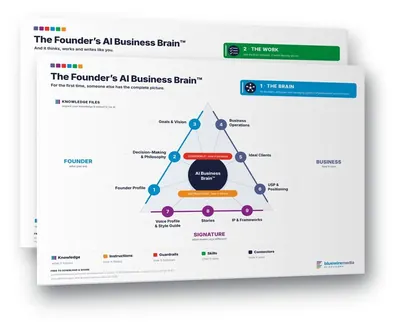
Want it to sound like you? The Founder's AI Business Brain template is how you get what's in your head into something that thinks, writes and works like you. Free to download.
Frequently asked questions
Why not just ask for a testimonial directly?
Because it turns weird really quickly. People say what they think you want to hear, and it sounds artificial and not very compelling. A debrief call gets you the same material without the performance.
Do I have to use Fathom specifically?
The technique is named after Fathom, which is what I record my coaching calls with. It just needs to be recorded, so you can go back and find the moment worth using.
What are the three questions?
What were the pain points before the project started. Where are you today, and what does life look like now. And what were the things you did to get from the before to the after.
When should I run the debrief?
Once a good project is underway or as it comes to an end, while the before is still fresh enough for the client to describe it properly.
What if the client says no to using it?
No worries. Either don't use it, or change the name and run a written version with the client anonymous.
What formats can the material become?
Email, video, or podcast. One recorded debrief can carry all three.