Most business owners don't need more stories. We've got plenty. We just need a way to save them and store them and use them in our content.
So what I use ChatGPT for is to help me extract all of those life stories that are sitting up here in my brain. It prompts me to share them, and then we can save them and file them and use them to create authentic content.
Why bother saving your life stories at all?
Because they're sitting up here in your brain, and you can't get to them at the exact moment you're writing a post or building a keynote, so they never make it out.
And that's a shame, because your stories are the one part of your content that AI cannot invent for you.
How do you get the stories out of your head?
There are three ways I do this.
1. Just ask ChatGPT to interview you
So one of the quickest ways to do this is to ask ChatGPT: "Ask me questions about all the meaningful moments and events that have happened throughout my entire life."
That's the easiest way. You ask that, it's going to send you a bunch of questions to answer, and you just go ahead and answer them. It breaks it into birth and early context all the way through, and there are loads and loads and loads of questions in there. That's a super simple starting point.
2. Use a set of questions you already like
The other way, if you've already got some questions that you like, is to use those instead. For example, my mate Vinh Giang, who's a communication specialist, shared all these questions that you can ask.
Ones like "when was a time you did something that seemed impossible?" and "is there a defining moment that captures your essence or mission?" That's another really good way of doing it.
3. Use a custom GPT built for it
Now, the third way that I have made easy for you is a GPT I built with loads of really good questions built into it. It's free for you to use, and if you'd like a copy, drop me a line and I'll send you the link. You pick exploration mode, and the beauty of this is it will ask you questions. You can answer it, you can skip it, or you can do it later.
So it asked me: "when did you surprise yourself with what you were capable of?" And I answered it for real. One time I surprised myself with what I was capable of was when I went bungee jumping for the very first time. It was in South Africa, on the Bloukrans Bridge, I think that's how you pronounce it. I did a bungee jump from, I think it was over a hundred metres high, and it was the highest in the world at the time. That was something I never thought I could do as a kid, and then when I was 22, I did it.
So that's as simple as it is. You give your answer, you send it off, and then what this GPT now does is give you the option to go deeper, go to the next question, or change category.
It used to be a bottleneck for clients to go through 25 questions and type out the answers, which is why this GPT makes it so much easier, especially when you've just got the function key and you just talk your answer in. So I use Wispr Flow. If you've watched my AI videos for a while now, you know that I love Wispr Flow to talk into it.
What do you do once you've answered enough?
But then once you've used this custom GPT and you've answered enough questions, you tell it you're done, or to pause for the day, or to give you all of your answers. And once you get all of your answers, it's going to format them in a nice easy way that you can then just export.
And the final piece of the puzzle, folks, is to take your life stories file and upload it into your own custom GPT.
Where do the stories actually get used?
So this is my AI Adam. It knows all about my writing style, my speaking style, my workshops. It's got my book loaded in there. So it's trained on all the ways that I speak and present and communicate. And now it's got my life stories baked into it as well.
So when I am coming up with a story, or a workshop activity, or something for a keynote presentation, I can ask it to draw on my life stories to come up with an analogy, or a story that might resonate with the audience, or something that highlights the point I'm making.
So it comes in super, super handy. It acts as a second brain, because it's programd with all the stuff that's in your head that you may not be able to access quite as quickly and easily as a GPT with it all loaded in.
In how to use AI without losing your writing voice I said AI isn't a bad writer, it just doesn't know you yet, and that the fix is sharing your stories with it. So this is how you actually do that bit. And it's the same reason your outputs feel flat when you skip it, which I unpacked in why AI gives you generic answers.
Your stories are also IP, in exactly the same way your frameworks and templates are. If that idea is new, have a read of unpack your IP.
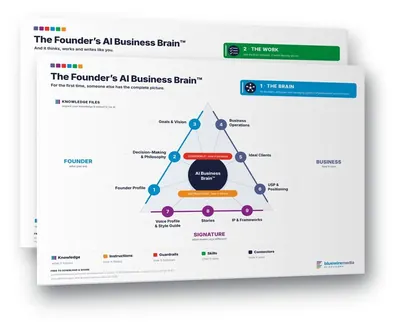
Want it to sound like you? The Founder's AI Business Brain template is how you get what's in your head into something that thinks, writes and works like you. Free to download.
Frequently asked questions
How do you use ChatGPT to save your life stories?
Ask it to interview you. A prompt as simple as "ask me questions about all the meaningful moments and events that have happened throughout my entire life" will send back a long set of questions, broken into birth and early context all the way through, and you just answer them.
Why would a business owner want their life stories in AI?
Because the stories are the part of your content AI cannot invent. Once they're loaded in, you can ask for an analogy or a story for a keynote or a post and it draws on your real life instead of a generic one.
What questions should you answer?
Whatever gets you talking. My mate Vinh Giang's set of 25 questions is a good starting point, with questions like "when was a time you did something that seemed impossible?" and "is there a defining moment that captures your essence or mission?"
Why was typing out the answers such a bottleneck?
It used to be a bottleneck for clients to go through 25 questions and type out the answers. Now you just talk your answer in, and that makes it so much easier. I use Wispr Flow, you've just got the function key, and you just talk your answer in.
Where do you put the life stories file once it's done?
Upload it into your own custom GPT, alongside whatever else it already knows about you. Mine holds my writing style, my speaking style, my workshops and my book, and the life stories sit in there with all of that.
Does this replace writing your own content?
No. It gives the AI something real to draw on so the content still comes from you. You're loading in the stuff that's in your head that you can't always reach quickly, and the AI helps you find the right one at the right moment.