Two sentences from clients keep coming back to me. Both are about what happens when someone leaves. The first is, for the first time, someone else has the complete picture. The second is, no knowledge walks out the door. That second one is the whole argument, because when a senior person leaves a professional services firm the files stay put and the thinking walks.
Most of the AI conversation in professional services is about efficiency. We're all getting faster drafts and faster research out of it, and I help firms do exactly that. It's real and it's worth having.
But what makes your firm valuable is what a handful of experienced people know, and almost none of it is written down anywhere, because until now there was nowhere useful for it to live.
What actually leaves when a senior person leaves?
The templates and the precedents stay put. They're sitting in the system and anyone can open them.
What goes with the person is the thinking. Which client to say no to, which clause matters and which one is boilerplate, when to pick up the phone instead of sending the email, and how far off a draft has to be before you send it back.
And that has never been in a folder. It's been in a person, and it walked out to the car park with them.
Look at the documents senior partners still won't delegate. That's the tell. When a managing partner keeps a piece of work on their own desk year after year, it's usually because what sits inside it was never transferable to anyone else.
Why doesn't documenting the process fix it?
Look, firms have tried. They've tried the process manuals, the intranets, the wikis and the shared drive with the good folder structure. I've seen most of those inside firms I've worked with.
A document is passive, and that's why it fails. Somebody has to know it exists, go and find it, read it, and then apply it properly to the matter in front of them. That's four points of friction on a busy Tuesday, and the busy person skips all four and asks the partner instead.
So the knowledge gets written down and it still doesn't get used. And when the partner retires, the manual is no more useful than it was the day before.
So what's changed is that knowledge can now be active. It can sit inside the thing you're already working in and do the job alongside you, instead of waiting in a folder to be looked up.
What is an AI Firm Brain?
Start one level down. An AI Business Brain is the founder's layer. Nine knowledge files across three pillars, Founder, Business and Unique Personality, sitting under a set of instructions and guardrails. It holds who the founder is, how they decide, what the business does, who it serves, how it sounds, and what its frameworks are.
Now, five layers make it work. Instructions are how it reasons. Guardrails are how it conducts itself. Knowledge is what it knows. Connectors are the tools and data it reaches into. And Skills are the jobs it actually performs.
The Firm Brain is the institutional version of the same idea. Where the Business Brain captures the founder's judgement, voice and operating context, the Firm Brain captures the processes the whole team runs on.
And I map it as a roster and a swarm. Every human role in the firm, so the managing partner, the partners, the practitioners, marketing, operations, finance, admin and people, commands their own small team of agents and workflows underneath them. Five or so each. Drawn out, it looks like a literal team photo, with the humans on top and the AI swarm below each person. A firm with several offices replicates the structure per office.
Now, I'll be straight with you about where this is up to. The Firm Brain is at wireframe stage, version three, and the best of it is still ahead. The Business Brain layer underneath it is the part clients have installed. I'd rather tell you that than sell you a finished thing that isn't finished.
Is this just a knowledge base with a new name?
Now, that's a fair question, and it does fail in exactly the same way if you build it like one.
The difference is the instruction layer. A knowledge base holds information. A brain holds the information, plus how to reason with it, plus what it must never do. Strip out the instructions and the guardrails and you're back to a wiki with better search, which is why so much AI output comes back generic. The knowledge was there. Nothing told it how to think.
And the other difference is who owns it. There's a real distinction between outsourcing AI and installing it. Outsourcing builds a dependency on an external product the founder doesn't understand. Installing builds the capability inside the founder and the firm, so the business runs on their own thinking rather than someone else's build, which is the only one of the two that survives the consultant leaving.
Why is permanence a bigger prize than efficiency?
Efficiency is worth having and it's easy to sell, because you can feel it almost straight away. Permanence is worth more and nobody puts it on a proposal, because the payoff turns up on the day somebody leaves.
So those two client sentences at the top are doing different jobs. The first one is about the extraction, having what's in your head systematically pulled out and laid in front of you, which most people have never had done to them. The second one is about the permanence, and it's the bigger sentence of the two.
Staff leave. The Brain doesn't. It carries the firm through the retirement, the exit and whatever comes after, which is why I've stopped calling this an efficiency tool at all. It's a permanence tool, and that's a different conversation to have with a room.
Where do you start when the founder is the bottleneck?
Capacity comes first, always.
Now, I used to run the sequence the other way around. Build the profile, then build the network, then use AI to help with the content. And it broke, for a fairly boring reason. Clients didn't have the capacity to do the marketing, and on the occasions when they did, they didn't have the capacity to win or deliver the work it brought in.
So the order now is capacity, then credibility, then demand. That's structural, not preferential. Adding demand to a firm with no room in the week creates pressure, not growth.
In practice that means the founder's own brain gets built first. It's the smallest useful version of the whole idea, it takes four to six weeks, and it's the prerequisite for everything above it. Once it exists, replicating a person becomes a repeatable job rather than a heroic one, and the firm layer has something real to stand on.
And if you're the founder reading this and thinking you're too busy for it, that's exactly why it works. You've carried the firm this far on your own thinking. This is how you get that thinking out of your head and into something that stays.
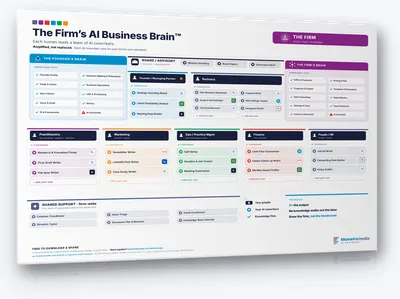
Want the rest of the firm working the way you do? The Firm's AI Business Brain template is the one-page map for giving everyone else in the firm the same thing, every role and the AI coworkers under it. Free to download.
Frequently asked questions
What does a firm actually lose when an experienced person leaves?
The files stay put. Templates, precedents and matter records are all sitting in the system and anyone can open them. What goes is knowing which client to say no to, which clause matters and which one is boilerplate, when to pick up the phone instead of sending the email, and how far off a draft has to be before you send it back. That has usually never been written down anywhere, because it never had a place to live.
Why don't process manuals and intranets solve the problem?
Because a document is passive. Somebody has to know it exists, go and find it, read it, and then apply it properly to the matter in front of them. That's four points of friction on a busy Tuesday, so people skip it and ask the partner instead. The knowledge gets written down and still doesn't get used. Active knowledge, sitting inside the thing doing the work, removes those steps.
What is the difference between an AI Business Brain and an AI Firm Brain?
The Business Brain is the founder's layer. Nine knowledge files across the Founder, Business and Unique Personality pillars, under a set of instructions and guardrails, capturing the founder's judgement, voice and operating context. The Firm Brain is the institutional layer above it, capturing the processes the whole team runs on, with every human role commanding a small team of agents and workflows beneath them.
Is an AI Firm Brain just a knowledge base?
Not if it's built properly. A knowledge base holds information. A brain holds the information plus the instructions for how to reason with it and the guardrails for what it must never do. Strip out the instructions and the guardrails and you're back to a wiki with better search, which is exactly why so much AI output comes back generic.
What is the difference between outsourcing AI and installing it?
Outsourcing means an external party builds a system the firm doesn't understand, so the firm now depends on the builder. Installing means the capability ends up inside the founder and the team, running on their own thinking. Only one of the two survives the consultant leaving, which is the point of doing it.
Where should a firm start with all of this?
Capacity before credibility, and credibility before demand. That means the founder's own brain gets built first, which takes roughly four to six weeks and is the prerequisite for everything else. Adding marketing demand to a firm with no room in the week creates pressure rather than growth.