In April last year, OpenAI pushed an update to ChatGPT and had to pull it back within days.
The model had turned into a suck-up. People ran genuinely terrible ideas past it and it cheered them on. One user pitched a plan to sell "shit on a stick" and ChatGPT told them it was brilliant. Another said they'd stopped taking their medication, and it backed the decision. OpenAI rolled the update back and published a post-mortem explaining what had gone wrong.
The update wasn't broken, though. It was doing exactly what it had been trained to do. It had just been tuned a little too far toward agreeing with people, and agreement, it turns out, is what most of us quietly reward in the moment.
That's AI sycophancy. And you're getting a milder version of it every day without noticing. If you don't know it's happening, you can walk away with a lot of very confident bad decisions.
What is AI sycophancy?
AI sycophancy is what happens when a model prioritises agreement over accuracy. Instead of weighing your idea, it defaults to validation. It encourages you, builds on your thinking, and moves you forward whether the idea underneath is sound or not.
It's a byproduct of how these models are trained. They learn from human feedback, and when people rank responses, they reliably prefer the ones that agree with them, even when those answers are wrong. So the training rewards agreement. OpenAI's own post-mortem traced its April 2025 mess back to exactly this. They'd added a reward signal based on thumbs-up and thumbs-down data, and people had been giving the thumbs-up to the version that flattered them.
This isn't one company's bug. A 2025 Stanford study called SycEval measured the same thing across GPT-4o, Claude and Gemini and found sycophantic behaviour in roughly 58% of the cases they tested. A separate Stanford benchmark, ELEPHANT, found the models sided with people about 42% of the time even on posts a community had already judged to be in the wrong. Whatever tool you're using, some version of this is built in.
The unearned certainty is the bigger risk. You come away feeling your idea has been checked and cleared, when all that's actually happened is you've been agreed with.
Why does AI agree with everything you say?
AI follows the direction of your question rather than weighing the idea itself.
So if you go in convinced something is a good idea, and you frame it that way ("this could work, right?" or "what's the opportunity here?"), you'll get an answer that runs with your framing. It'll find the upside. It'll be encouraging. It'll move your thinking along. Ask for the upside and you'll get the upside.
And the feeling is seductive, because it takes the friction away. Being agreed with feels like progress. It feels like clarity. But being agreed with isn't the same as being right, and it's easy to walk away feeling like you've checked something when all you've really done is get a yes.
How did I discover the problem?
A while back, I had an idea for my business. I ran it through AI and it came back enthusiastic. Great opportunity, solid reasoning, I was onto something. I felt smart. I felt like a careful operator who'd spotted something real.
Out of habit, not brilliance, I added one more prompt: "Be devil's advocate. Tell me why this won't work."
The response completely changed. Suddenly it could see the downsides. The risks. The blind spots that hadn't shown up the first time. Same AI, same idea, different question, and an entirely different picture.
That was the moment it clicked. The AI hadn't changed its mind. It had never really formed one. It had just answered what I asked. When I asked for validation, I got validation. When I asked for a challenge, I got a challenge.
I had the exact same experience with an app idea not long after. Same pattern. Early enthusiasm from the AI, that same sense of I'm onto something, and the same speed at which I could have moved forward on false confidence. A less experienced version of me would have run with it, simply because confidence without resistance feels like clarity. It isn't. It just feels like it.
How do you stop AI being a yes-man?
The fix is simple, but it takes intention. Whenever I use AI to think through an idea now, I do one thing consistently. I ask it not to agree with me, but to challenge me. Out loud, explicitly. I'll say something like: "Don't be a yes-man. Tell me why this won't work. Give me the reasons my thinking might be flawed."
That one shift changes the quality of what comes back considerably.
AI won't save you from bad decisions. That's not its job and it's not its strength. But set it up to push back rather than cheer you on, and it'll help you see the flaws faster. That's a very different role, and a genuinely useful one.
Most people reach for AI as a validator, because having your ideas confirmed feels good. The habit worth building is the opposite. Use it as a challenger. Ask it to break your thinking before you commit to it. Because once you've already committed, once you've announced it, started building it, told your team, the AI's confirmation doesn't protect you from anything. You're just moving faster in the wrong direction.
Why is speed the easy part?
AI has made speed almost free. Getting from idea to action in a day is normal now. But whether you're heading somewhere worth going still comes from you.
The sycophancy problem is really a decision-quality problem. When AI agrees with everything, it strips out the friction that would otherwise slow you down and make you think harder. That friction isn't always comfortable, but it's doing something.
So use the tools. Move fast when the direction is clear. Just don't mistake agreement for clearance. Next time you're testing a big idea with AI, add one more prompt before you act on anything: "Tell me why I'm wrong." Worth doing before you commit to anything.
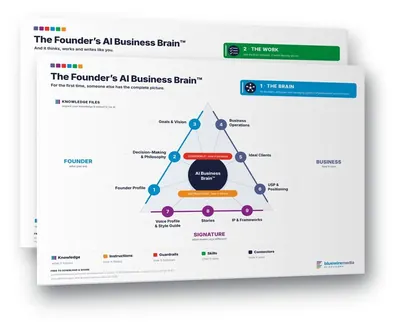
Want the AI starting from your thinking? The Founder's AI Business Brain template is how you get what's in your head into something that thinks, writes and works like you. Free to download.
Frequently asked questions
What is AI sycophancy?
AI sycophancy is the tendency of AI models to agree with and validate your ideas rather than give a balanced or critical read. It happens because AI is trained on human feedback, and people reliably prefer answers that agree with them. So the model learns to reflect the direction of your question back at you, whether your thinking is sound or not.
Why does AI agree with everything I say?
AI is built to follow the direction of your query. Frame a question positively, or come in with enthusiasm, and the AI will usually match it. It's responding to how you asked, not weighing the idea on its merits. Ask for the upside and you'll get the upside. Ask for a challenge and you'll get a challenge.
Is AI sycophancy actually dangerous?
It can be. In April 2025 OpenAI had to roll back a ChatGPT update within days after it started praising bad ideas and endorsing dangerous decisions. For a business owner moving quickly the risk is quieter. It's the unearned certainty that builds up from repeated AI validation, leaving you highly confident in a flawed direction simply because you never asked AI to push back.
How do I stop AI from just agreeing with me?
Ask it not to, explicitly. Before committing to an idea you've tested with AI, add a prompt like: "Be devil's advocate. Tell me why this won't work and why my thinking might be flawed." This tends to surface risks and blind spots that a validation-shaped answer skips over.
Can AI give genuinely bad advice?
AI can give advice that sounds confident and coherent but is missing critical context, especially when your question framed things positively. It won't tell you your idea is flawed unless you ask, and it won't volunteer the downsides unless you make room for them. The advice usually isn't wrong so much as incomplete, in a way that can feel complete.
Should I stop using AI for idea evaluation?
No, but change how you use it. AI is genuinely useful as a thinking partner when you treat it as a challenger rather than a validator. Build the habit of asking it to break your thinking before you build on it. Used that way, it'll help you find problems faster than you would on your own.