Now, there's three levels that business owners advance through with AI. Level one is speed, where AI does the admin tasks faster and better than you could before. Level two is thinking, where you use the time you got back for the advising and deciding work your clients pay for. Level three is leverage, where AI handles the systems for your whole team and not just for you.
Now, if you've ever felt overwhelmed by the sheer volume of grunt work and admin and all those things that you hate about business, or that you don't love about business, then AI is going to be your friend.
It's not here to replace you, but it's here to let you decide where you spend your time.
What are the three levels of AI in a business?
So, the first level is speed. Level two is where you're doing more thinking. And the third level is to have AI help with leverage.
What does level one, speed, actually give you?
This is where you can get AI to do task-based things. So, basically admin tasks that you can now do faster and better than you could before.
Now, this is great because you might be saving 10 or 15 minutes per task, and they add up pretty quickly to get some extra time in your calendar. It's not unheard of to get 5 or 10 hours back in your calendar quite quickly.
Now, what you do with those hours is what moves the needle the most. I've made a similar argument a different way in the post on why speed is not the real AI advantage.
What is the trap at level one?
The trap is slipping back into admin, task-based, doing work, just because you've got that extra time.
You want to avoid that, and you want to elevate yourself to level two, where you're doing more thinking.
What does level two, thinking, look like?
So, if you can put those 10 hours to work and do more of that thinking, advising, consulting and coaching work that your clients pay for and that you enjoy, then you're going to be doing much higher value work, and it's going to be more energising and more profitable.
So, that's really the first phase of getting from admin stuff to the advisory part of the business. It's also where you start using AI as a thinking partner, which I've written about in how I think first and never let AI decide.
What is level three, leverage?
And then the third level is to have AI help with leverage. So, here you are going from the deciding, the thinking, all the way up to you leading the team, running the business, but letting AI handle all the systems.
So, it's not just about you and your own personal advice that you give clients, it's about your team and providing the AI systems and tools so that your team can be doing better work. I've written about doing that for yourself in replicating yourself, and about giving AI hands as well as a brain.
I talk about this level with accounting firms and financial advice practices.
Does level three mean cutting head count?
So, there's no extra head count, and you're not letting anybody go.
What you're doing is you're having a business that grows and scales, and it operates so much better, because AI is handling a lot of that work for everybody and not just you.
How do you know which level you're on?
All right, so the three levels. Number one, level one, you're doing it for speed. You get some time back in your calendar, you move to level two, you use that time for more thinking, and you have AI as a thinking partner so that you can make better decisions and get better advice. And then if you own the business as well, then you can use that time to focus on the leverage side of things and lead your team, so that you're directing as opposed to doing and deciding.
So, they're the three levels. AI won't replace you, but it does allow you to decide where you spend your time.
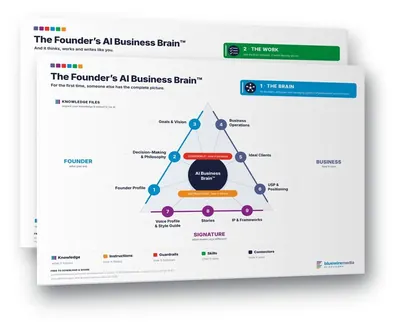
Want the AI starting from your thinking? The Founder's AI Business Brain template is how you get what's in your head into something that thinks, writes and works like you. Free to download.
Frequently asked questions
What are the three levels of AI for a business owner?
Level one is speed, where AI does admin and task-based work faster and better than you could before. Level two is thinking, where you use the time you got back for thinking, advising, consulting and coaching. Level three is leverage, where AI handles the systems so your whole team can be doing better work, not just you.
How much time does level one actually save?
You might be saving 10 or 15 minutes per task, and they add up pretty quickly. It's not unheard of to get 5 or 10 hours back in your calendar quite quickly.
What is the trap at level one?
The trap is slipping back into admin, task-based, doing work, just because you've got that extra time. You want to avoid that, and you want to elevate yourself to level two.
Why is level two more profitable than level one?
Because thinking, advising, consulting and coaching is the work your clients pay for and that you enjoy. So you're doing much higher value work, and it's going to be more energising and more profitable.
Does level three mean replacing staff with AI?
No. There's no extra head count, and you're not letting anybody go. What you're doing is you're having a business that grows and scales, because AI is handling a lot of that work for everybody and not just you.
What does level three change day to day?
You're directing as opposed to doing and deciding. AI won't replace you, but it does allow you to decide where you spend your time.