Any decision that lands on your desk more than once. If the same decision keeps coming back to you, it's not a workload issue, it's a design issue, and the answer is to capture your judgement properly and then use AI so that question never reaches you again. And the decisions you made for a different version of you, which no longer fit where you are now, are worth letting go of too.
Why does the same decision keep landing on your desk?
Touching fewer things with AI is one level, but the next level you want to get to is deciding once. Now, here's what was making me uncomfortable. I realised that I was making the same decision twice or more.
And that meant that the system wasn't finished. Because if I was making the same decision over and over again, it meant that it kept drawing me back in.
For me it was what's happening next with my content. Because each piece of content kept coming back to me even once I'd done the high-level thinking and delivery. So every checkpoint needed my approval, and all I'd really done was make myself the bottleneck.
Now, when I'm away speaking or doing workshops, or just with my family or in client meetings, my to-do's kept piling up. And honestly, it's low-value work. I wasn't deciding strategy. I wasn't working with clients. I was just policing a low-level process.

Is it a workload problem or a design problem?
Most people agree that AI saves you time. And yes, it does. The real shift for me is that AI should actually be reducing or eliminating recurring decisions.
Because if the same decision keeps landing on your desk, it's not a workload issue, it's a design issue. And in fact, most business owners realistically don't have a workload problem. What it actually is, is a design problem disguised as a workload problem.
So I had to ask myself, why am I deciding this again and again? And the answer for me wasn't delegate harder, even though I could. The simple answer was let's capture that judgement properly and then use AI.
So I created a content playbook, complete with all the steps, the prompts and the exact outputs that I wanted, plus the decision-making logic to decide whether a piece went on my personal blog or my company blog. So it's quite a detailed process, and that's part of the reason it kept coming back to me, because it was all trapped up in my head. But with AI, I could unpack it out of my head, and rather than me being the checkpoint for each step, AI does the steps and applies the logic to decide if it's ready to go to the next one. I've written about what that workflow did to the shape of my week. Now, a VA oversees the whole thing, and it doesn't touch my desk again until the final approval, and that's even if I want to look at it.
How do you tell a decision that needs your judgement from a process?
So the filter that I now use is, if a decision lands on my desk more than once, I stop and ask, is this actually requiring my judgement or is it a process? If it's a process, that process needs designing.
And most senior business owners, like me and like you, should not be answering the same question again and again, particularly if it's a lower-level, process-driven decision. We should be designing systems so that question never reaches you again.
Because as you can appreciate, every time you have to make that decision, albeit a low-value, low-stakes decision, it is draining you and your bandwidth. And if it's draining that, it's draining your judgement, and judgement is the scarce asset for business owners.
So productivity makes you faster at doing, but leverage removes the need for you to actually do it again. That's the third of the three levels of AI: we don't just want to get faster at the doing, and we don't just want to touch fewer things, we want to remove some things entirely, particularly those recurring decisions.
What about decisions you made for a different version of you?
There's a second kind of decision that should leave your desk, and it's the part most people miss. A lot of decisions don't fail because they were bad ideas. They fail because they were made for a different version of you.
You decide things like, I'll do that in six months, I'll revisit it next year, I'll commit when things settle down. And at the time, that makes sense. But six months later, you've changed. Your standards are different. Your energy is different. Your priorities are different.
So what looked like a good decision back then, when you mentally committed to it, no longer fits where you are now. And that's where AI becomes useful, not as a calculator, but as a mirror. I made a short video on letting go of decisions that no longer fit if you'd like to watch it.
And this matters more once you're no longer deciding from scarcity. When you already have a business that works, when people trust you, saying yes to the wrong thing doesn't just cost time, it costs focus, energy and reputation. So at that stage, the question isn't will it work. It's does this belong in my life and in my business now?
How do you use AI to check whether an old decision still fits?
So that's why I'll often run decisions through AI before I commit. Not to get an answer, but to pressure test my thinking. I'll say things like, here's the version of my business or myself that I'm building towards. Here's my strategic plan, or here's my 2026 goals. Here are my non-negotiables. Here's what I'm no longer willing to trade.
And then I'll ask, given that, does this decision align to me, and does it still make sense?
So what comes back is usually clarity, not persuasion. Sometimes it will confirm the decision. Sometimes it will quietly challenge me and say, that was a good decision for you back then, I can see why you made it, but remember you're heading in this direction now, or this thing has changed. The decision is still mine, which is the same reason I think first and never let AI decide.
And when your decisions are aligned with your identity, they tend to feel lighter, cleaner and easier to stand behind. If the harder part for you is committing at all, I've written separately about why experienced business owners get stuck on decisions.
So if something keeps landing on your desk, don't just keep clearing it away faster and faster and faster. Design it and allow AI to handle it. And if this resonates, pay attention to the questions that you're asking AI, not just the outputs that you're getting, because better questions lead to better alignment, and better alignment leads to better decisions.
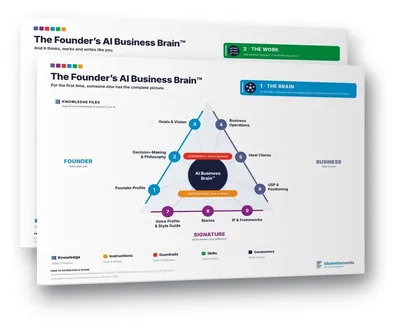
Want AI checking decisions against where you're heading? The Founder's AI Brain™ Template helps you build an AI Brain: a folder of files on your drive that helps AI understand you and your business, including your goals and your non-negotiables. Free to download.
Frequently asked questions
Which decisions should leave my desk?
Any decision that lands on your desk more than once. If the same decision keeps coming back, it's a design issue, and the answer is to capture your judgement properly and use AI so that question never reaches you again. The decisions you made for a different version of you, which no longer fit, are worth letting go of too.
How do I know if a decision needs my judgement or is a process?
If a decision lands on your desk more than once, stop and ask, is this actually requiring my judgement or is it a process? If it's a process, that process needs designing, particularly if it's a lower-level, process-driven decision.
Why is a recurring decision a design problem rather than a workload problem?
Because if you're making the same decision over and over again, the system wasn't finished and it keeps drawing you back in. Most business owners realistically don't have a workload problem. It's a design problem disguised as a workload problem.
Why does a small, low-stakes decision matter?
Every time you have to make that decision, albeit a low-value, low-stakes decision, it is draining you and your bandwidth. If it's draining that, it's draining your judgement, and judgement is the scarce asset for business owners.
How can AI help me let go of a decision that no longer fits?
Use AI as a mirror, not a calculator. Tell it the version of your business or yourself that you're building towards, your strategic plan or goals, your non-negotiables and what you're no longer willing to trade. Then ask, given that, does this decision align to me, and does it still make sense?
Does AI make the decision for me?
No. You run the decision through AI to pressure test your thinking, not to get an answer. What comes back is usually clarity, not persuasion. Sometimes it will confirm the decision, and sometimes it will quietly challenge you because something has changed.