When a firm with several offices brings AI in, it doesn't land everywhere at once. Some offices move quickly. Others have different time commitments and get to it later. That's the normal shape of it.
What you see across those offices is a range of people meeting the same technology from different angles at the same time. One person charges at it. Another wants legal advice on it before anybody goes near a client file. Somebody brand new to it comes at it with a fresh set of eyes.
Here is what that looks like in practice, and why it tends to work well.
What does a multi-office rollout actually look like?
A few months in, one office is well down the track and another is just getting going.
The office out in front usually has an internal champion. Somebody driving it because they want to, sharing the excitement with everyone around them. They'll uncover things well before anybody else does, and they'll do it under their own steam, which isn't something you can mandate.
The office taking longer has its own time commitments, and being flat out with client work is the usual one. They chose the client in front of them, which is what you'd want them to choose.
So you end up with people at different points, and each of those points is doing something for the firm.
Who do you tend to see across the offices?
Four people, and across four or five offices you'll usually find all four.
The champion. The one driving it internally and sharing the excitement. They'll uncover things well before anybody else does, and they'll do it because they want to.
The compliance-conscious one. The person who provides a level of insight and oversight that stops everybody getting carried away.
The fresh set of eyes. Somebody brand new to AI, who has none of the assumptions the rest of you picked up along the way.
The systems person. The one who wants to unpack how the work actually gets done and then share it with everyone else. They turn one person's discovery into the firm's.
What does the compliance-conscious person bring?
They ask the questions that buy the firm total peace of mind, and they ask them early.
They're the ones who say let's get some legal advice on all this. Let's talk to our IT people and double-check that the security settings and the permission settings are all a hundred per cent. Those are exactly the right questions, and they're cheap to ask early.
The champion and the cautious one are working on the same thing from two ends. One finds what's possible, the other makes sure the firm can stand behind it. Between them the firm gets both.
It's the same balance I teach on stage with the 10-80-10 rule, where the human does the first ten per cent and the last ten per cent and AI does the middle. That last ten per cent is somebody's professional expertise, applied on purpose, and the compliance-minded people in your firm understand that part well.
What does the newcomer see?
The obvious thing, usually.
Once you've been using AI for a while you build up a set of assumptions about what it can and can't do, and some of those assumptions go out of date within a month. Somebody coming to it new has none of them. They'll ask why a job is done the way it is, and sometimes the answer is that it was the best way available last year.
They also give you an honest read on how hard it is to get started, which is the thing the champion can no longer see. If a newcomer in your firm can get a real result in their first week, your onboarding works. That's worth knowing.
And if anybody in the firm feels behind on all this, I'd say what I've written before. Feeling behind is a good sign, because it means they're taking it seriously enough to compare.
How does what one office works out reach the others?
An office that's running hard is learning things every week. They learn what works on your kind of work, and where it needs watching. That's real knowledge about your firm specifically.
Give it somewhere to live. When the process and the client rules sit in one place the whole firm reads, the champion's week becomes everybody's week, and the compliance work one office has already done doesn't get done again from scratch in the next one. That's the same idea as making sure no knowledge walks out the door, working sideways across the firm rather than out of it.
The systems people love this part, and they're usually the ones to hand it to.
What happens when those people meet each other?
Once you can see who is who, most of it takes care of itself.
The champion's work gets looked over by somebody who knows what to look for. The careful one gets to see what's actually possible rather than hearing about it second hand. And the office that's had a quieter run picks up something concrete to get going on rather than a general sense of catching up.
I run this across accounting, financial advice, broking, property, legal and medical, and the pattern holds in all of them.
So if your offices are all at different stages right now, that's the shape of it, and everything you need is already in the building.
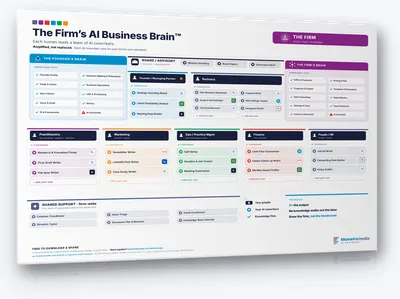
Want one place the whole firm learns into? The Firm's AI Business Brain template is the one-page map for giving every office and every role the same context to work from. Free to download.
Frequently asked questions
Is it normal for our offices to be at different stages with AI?
That's the normal shape of it. Some offices move quickly, others have different time commitments and get to it later. What you end up with is a champion driving it in one place, somebody asking the careful compliance questions in another, somebody brand new with no assumptions, and somebody who wants to write the process down and share it. Across four or five offices you'll usually find all four.
What does an internal champion do for a firm?
They go as hard as they can and they share the excitement, which isn't something you can mandate. They'll uncover things well before anybody else does, because they want to. Give them a bit of slack in their week and a reason to care, and the rest follows.
What does the compliance-conscious person bring?
They provide the insight and oversight that stops everybody getting carried away. They're the ones who say let's get some legal advice on this for total peace of mind, and let's talk to our IT people and double-check the security and permission settings are a hundred per cent. Those questions are cheap to ask early. The champion finds what's possible and the careful one makes sure the firm can stand behind it, and between them you get both.
What is the value of somebody who is brand new to AI?
They have none of the assumptions the rest of you picked up along the way, and some of those assumptions go out of date within a month. They'll ask why a job is done the way it is, and sometimes the answer is that it was the best way available last year. They also give you an honest read on how hard it is to start, which is the thing the champion can no longer see.
How do we get what one office learns across to the others?
Give it somewhere to live. An office running hard is learning things every week about your kind of work and where it needs watching, and that's knowledge about your firm specifically. When the process and the client rules sit in one place the whole firm reads, the champion's week becomes everybody's week, and the compliance work one office has already done doesn't get repeated from scratch in the next one.
What happens when those people meet each other?
Once you can see who is who, most of it takes care of itself. The champion's work gets looked over by somebody who knows what to look for, the careful one gets to see what's actually possible rather than hearing about it second hand, and the office that's had a quieter run picks up something concrete to get going on.