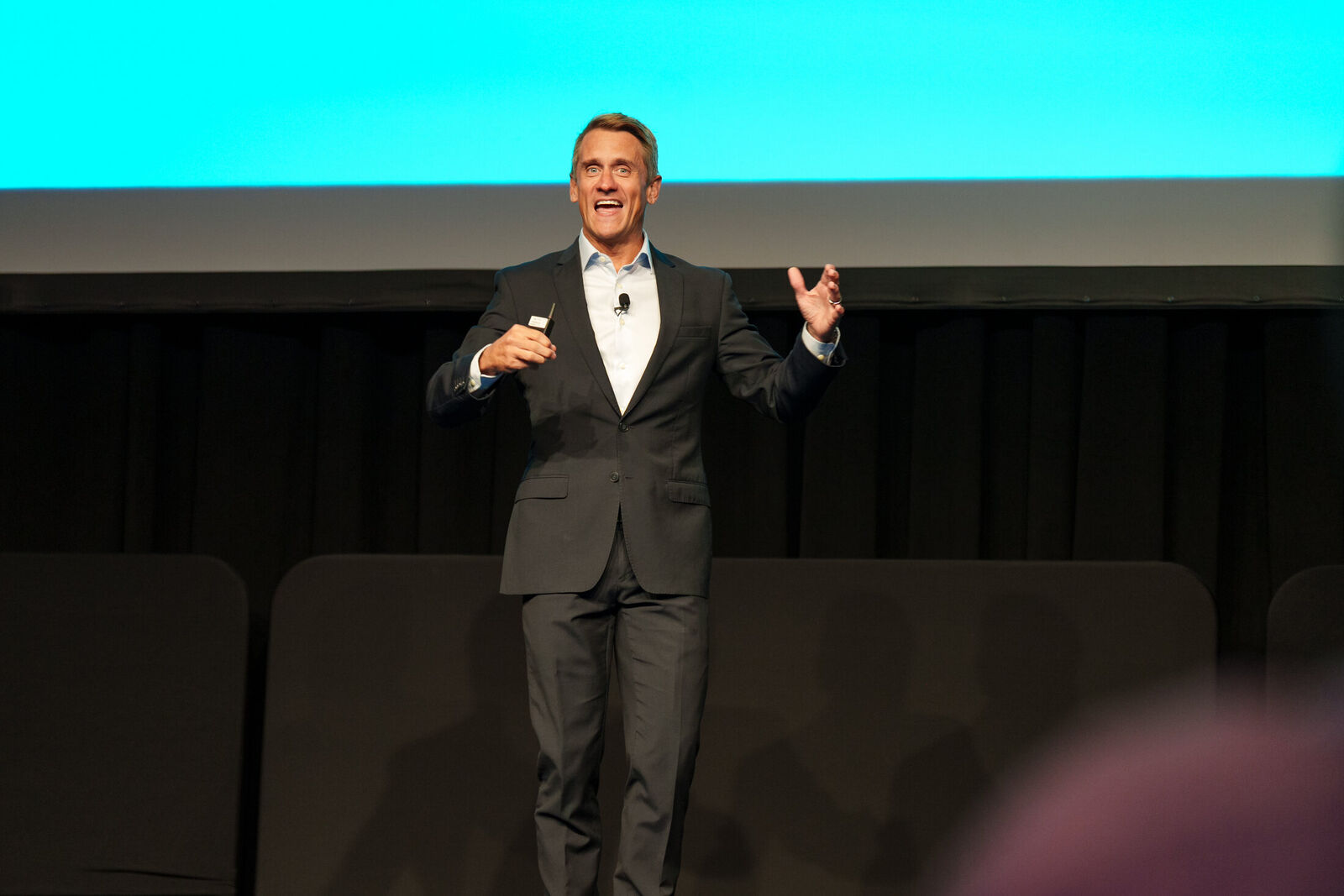
Back in 2025 I gave a talk called The Truth About Agentic AI at the Broker Innovation Summit in Melbourne. So when a program committee asks whether I am a futurist, I know the shape of what they are asking. It comes up often enough that it sits as a question on my own site, and the answer there is one line. I am practical, not a futurist.
But one line does not help you write a brief or defend a choice to your committee. So this is the longer version.
The short of it is that a futurist widens the horizon and hands your audience a picture of where things are heading. A practical AI speaker hands them a resources pack they can open on their own laptop that week. Both are real jobs, and the expensive part is booking one when your brief was written for the other.
What does a futurist actually do on stage?
A futurist does horizon work. They take a room that is heads-down in client work and they lift everyone's eyes to what might be coming.
And the value in that is real. Some rooms have been busy building the firm and have not had a reason to look up at AI yet, and a horizon session gives them one.
What a horizon session leaves behind is a changed picture of the world. A prediction is a hard thing to act on once you are back at your desk.
What does a practical AI session leave behind?
The test I use is a simple one. Can someone in the room open their laptop on Monday, use the thing they just watched, and get a result before lunch?
So every attendee leaves my sessions with an AI resources pack, guardrails and workflows included, that they can use the same week, tailored to their own profession. Audiences commonly report saving five to ten hours a week within the first month of applying what they learn.
I am also honest on stage about where AI helps and where it does not, and that counts for a lot in front of a compliance-bound audience.
The thinking underneath the tools is the part I care about most. I teach the 10-80-10 rule, where the human does the first ten per cent and the last ten per cent and AI does the middle. And I am matter-of-fact with a room that you never hand the decision over. Those two ideas travel further than any tool I demonstrate, because the tools will change and the way your members hold them will not.
Which one does your audience actually need this year?
Look, this is the most useful question on the list, and it is worth putting to your committee before anybody starts shortlisting names.
Ask where your members actually are with AI right now. I ask an organiser that on every briefing call, straight after the basics of audience, date, time and location.
If your members have not started, a horizon talk can be exactly the right call, because a reason to care has to come before a resources pack. If they have already started, and plenty of rooms have, then they have done the hard part. They have licences, they have had a go, and some of it is working. That room has already arrived at the conclusion a horizon talk is built to deliver, so a second one confirms them without moving them anywhere.
And if you covered AI last year, the second session has to be different in kind. A talk of the same shape with fresher predictions in it will feel to your members like being told about AI one more time.
Can you book both?
You can, and if your program has room for two they do different jobs.
The pairing I know best is a keynote plus a workshop, and many organisers book those the same day or the day after. The keynote plants the idea and the workshop does the installation, so the room leaves with AI actually set up and running. A horizon session and a practical session can share a program the same way. Which order suits you is your call, and it comes down to what you want the room carrying out of the last session.
On a single-day program you are choosing, and then it comes back to where your members actually are.
How do you tell the difference before you book?
You can usually tell from the showreel and the topic list. I would ask two questions, and they do most of the work.
The first one is about what the audience physically walks out with. If they walk out with notes, you have a horizon speaker. If they walk out with something they can open on the train home, you have the other kind. I ask every organiser for permission to share that pack with their audience, and I frame it as a gift to the audience, never as lead capture for me.
The second one is about tailoring. Is the session built for your profession and its compliance world, or is it a general AI talk with your industry dropped into the examples? Ask what the speaker will change for your room, and ask them to be specific about it.
Then there is the awkward question, which is proof. Ask which conferences in your own sector the speaker has already stood in front of. The list of rooms answers the thing your committee is really asking, which is whether this person understands people like our members. Mine has the Better Business Summit, AREC, PMX, The Adviser and the Broker Innovation Summit on it, and I would want you to check that before you check anything else.
Does practical mean boring?
Practical does not mean boring, and I understand why the question gets asked.
When I ask a conference organiser what they are most looking for in a keynote speaker, most of them say some version of the same thing. We cannot have the audience tune out and doze off to sleep, so you cannot be boring.
Practical means the room is on the edge of their seat thinking, wow, the pennies are dropping. I can see this. This is exciting. I just want to go away and implement this stuff.
And nobody needs to be sold on AI being important any more. I have written before that feeling behind on AI is a good sign, and most rooms are well past the "this matters" stage. They are stuck on what to actually do on Monday, and that is a practical problem.
What should your brief ask for?
If you are the one writing it, a few things are worth naming.
Ask for the session to be built for your profession and its compliance world, because a generic AI talk with your industry pasted into the examples is a different product. Get it in writing what the room leaves with, and whether it is tailored to your profession or handed out the same to everybody. I would also ask what the speaker will say about the limits.
Then check the date early. Most events book around six months ahead, with one to two months the practical minimum, so it is always worth asking. The sessions that fall over tend to fall over on availability rather than on fee.
The formats are worth knowing too. A main-stage plenary, a conference breakout, a hands-on workshop or a virtual session are different jobs, and many organisers book a keynote plus a workshop the same day or the day after, so the room installs the thing while it is in front of them. I run all four across accounting, financial advice, broking, property, legal and medical.
Not sure which session your program needs? Tell Adam about your event and he will advise the right format and respond directly. Keynotes, breakouts, workshops and virtual sessions for professional services conferences.
Frequently asked questions
What is the difference between a futurist and a practical AI keynote speaker?
A futurist does horizon work. They lift a room's eyes to what might be coming, and they send people away with a changed picture of the world. I work on the week after the conference, so every attendee leaves with an AI resources pack, guardrails and workflows included, that they can use the same week, tailored to their own profession. Both are real jobs, and the question for your committee is which one your brief was written for.
Which one does our conference need?
Start with where your members are with AI right now. If they have not started, a horizon session often suits them, because a reason to care has to come before a resources pack. If they have already started and have some of it working, they have arrived at the conclusion a horizon talk is built to deliver, so that room is ready for the practical session. And if you covered AI last year, the second one has to be different in kind. A talk of the same shape with fresher predictions will feel to your members like being told about AI one more time.
Can we book a futurist and a practical AI speaker at the same conference?
You can, and if your program has room for two they do different jobs. The pairing I know best is a keynote plus a workshop, which many organisers book the same day or the day after, where the keynote plants the idea and the workshop does the installation. A horizon session and a practical session can share a program the same way, and which order suits you comes down to what you want the room carrying out of the last session.
How can a program committee tell the difference before booking?
I would ask two questions. What does the audience physically walk out with, and is the session built for your profession or handed out the same to everybody? If they walk out with notes you have a horizon speaker, and if they walk out with something they can open you have the other kind. Then there is the awkward one, which is proof. Ask which conferences in your own sector the speaker has already stood in front of.
Does a practical AI keynote mean a boring session?
Practical does not mean boring. When I ask a conference organiser what they are most looking for, most of them say the same thing, which is that they cannot have the audience tune out and doze off to sleep. Practical means the room is on the edge of their seat thinking the pennies are dropping, this is exciting, and I just want to go away and implement this stuff. Most audiences are already past the stage of needing to be told AI is important, and they are stuck on what to do on Monday.
What should we put in the brief, and how far ahead should we book?
Ask for the session to be built for your profession and its compliance world, and get it in writing what the room leaves with and whether it is tailored to your profession. I would also ask what the speaker will say about the limits. On timing, most events book around six months ahead, with one to two months the practical minimum, so it is always worth asking. The sessions that fall over tend to fall over on availability rather than on fee, so check the date early.